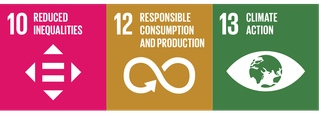
The principle of equality does not stop at the atmosphere
A constitutional review impulse for equal atmospheric starting rights,
interpersonally fair distribution of the remaining CO2 budget and socially balanced climate policy

The non-profit organization for sustainable economy SaveClimate.Earth identifies a previously under-examined constitutional question: Is our traditional understanding of equality and freedom still relevant in light of the climate crisis?
The focus is not on the demand for more "blanket" climate protection, but rather on the specific question of whether, in a world with strict ecological limits, the pure market mechanism ("whoever
is rich is allowed to pollute more") violates the constitutional right to equality. This initiative demands that "usage rights" to nature be distributed either absolutely fairly (e.g., per
capita) or that access be regulated in such a way that wealth no longer constitutes a privilege to destroy nature.
We encourage a discussion on whether this could lead to a constitutional complaint or a political initiative concerning the Basic Law.
The core conflict:
- The reality: Those with more money emit significantly more CO₂ on average (larger houses, air travel, consumption in general). Wealthy people, therefore, effectively take a larger "piece of the pie" of the remaining global emissions budget.
- The criticism: The question under review is whether it is fair that a limited common basis for life (a stable atmosphere) is treated like a normal market segment that can be secured by the highest bidder.
- The demand: The German Federal Constitutional Court's climate ruling (2021) states that the remaining carbon budget must not be consumed unilaterally at the expense of future generations (intertemporal). In addition, the question arises as to which equality standards should govern the currently permissible use of the atmosphere among people living today (interpersonal).
Key questions:
1. Equal atmospheric starting claim: Does Article 3 of the Basic Law need to be constitutionally re-examined and possibly further developed under the conditions of planetary boundaries, so that atmospheric usage rights are no longer effectively dependent on income, wealth, or economic performance?
2. From intertemporal to interpersonal emissions justice: Does Article 20a of the Basic Law need to be interpreted, following the Federal Constitutional Court's climate decision, so that remaining CO₂ budgets are arranged not only intertemporally but also interpersonally in conjunction with Article 3 of the Basic Law?
3. Social proportionality considering the principle of the least severe means: Is it okay for climate policy measures to mainly work through price increases if they regressively burden lower-income households, while equally suitable but socially milder instruments are conceivable?
Conclusion: Overall, the question arises whether personal, equal, and tradable emission budgets could be a tool worth looking into legally, to connect ecological limits, democratic equality, and social balance.
Climate justice as a question of democratic equality
The use of the atmosphere requires equal starting rights.
The climate crisis is more than just an ecological or technological challenge. Above all, it is a question of justice—and therefore also a question of democratic equality. For the atmosphere is not an ordinary commodity: it is our shared foundation for life. It does not belong to individual states, corporations, or wealthy private individuals—it cannot be owned. Therefore, its use is a constitutional question of distribution that needs to be resolved.
Our current economic system allows for a disproportionate amount of climate-damaging emissions, driven by capital. This occurs, on the one hand, at the industrial level, within the framework of the European Emissions Trading System (EU ETS). Companies with greater capital can purchase more allowances and thus emit more pollutants. While the EU ETS has a built-in emissions control mechanism, more capital can buy more emissions.
This imbalance also extends to the private sphere. Wealthy individuals, due to their consumption patterns, can pollute the atmosphere more than those with lower incomes.
The blind spot of modern democracies
While political participation is deliberately decoupled from wealth,
the use of the atmosphere is still essentially tied to economic purchasing power.
Those with more money can fly more often, heat larger living spaces, drive bigger vehicles – generally consume more – and thus claim a significantly larger share of the remaining emissions budget. People with lower incomes, on the other hand, have only limited access to these options. At the same time, however, they are often more severely affected by the consequences of the climate crisis – yet they often produce significantly fewer emissions. This asymmetry contradicts the idea that basic living conditions are a right for all people equally. Modern democracies are therefore based on a non-negotiable principle: fundamental participatory rights are deliberately decoupled from wealth.
Examples:
- One Person - One Vote: Every person counts equally when casting a vote. More wealth does not lead to additional voting rights.
- One Law for Everyone: People must not be treated differently in court because of their different economic strength.
- One Person – One Human Dignity: A person's dignity does not increase with their wealth and is not diminished by poverty. It is not for sale, not subject to tiered pricing, and not dependent on social status.
Modern democracies explicitly reject the idea that fundamental rights should be distributed proportionally to wealth. The state also actively intervenes in certain areas to ensure justice. This is a fundamental principle of modern democracies.
Examples:
- Progressive income tax: Higher incomes are deliberately taxed more heavily to ensure social justice and equal opportunities in life.
- Minimum wage: The state intervenes in the freedom of contract in order to uphold human dignity and protect employees from unfair power relations.
- General Equal Treatment Act (AGG): The state prohibits discrimination and intervenes in private contracts to ensure equal treatment.
The principle of equality currently ends with the use of the atmosphere
Article 3 of the Basic Law states that all people are equal before the law.
However, this principle of equality remains incomplete to this day when it comes to the use of the atmosphere.
Because although the atmospheric limit is finite and the same for all people, more economic purchasing power also enables more emissions and thus a significantly greater strain on the remaining emissions budget.
This system is not only socially unfair but also politically short-sighted. It treats the atmosphere like a luxury good that the wealthy are allowed to appropriate on a larger scale. But the atmosphere is not private property; it is the common basis of life for all people. If its use is limited, access to it must not depend on wealth.
This current interconnectedness results in massive systemic problems:
➡️ The use of the atmosphere is being privatized, while the devastating costs of climate change are socialized and imposed on younger people and future generations.
➡️ The use of fossil resources is predominantly based on financial strength rather than ethical criteria – ability to pay rather than fairness.
➡️ Climate-damaging behavior is primarily regulated through price and therefore cannot be reliably limited by physical means.
➡️ The atmosphere is treated like an unlimited commodity that wealthy people are allowed to appropriate to a greater extent.
The current system thus enables emission opportunities not according to principles of equality, but through an unequal and unfair overexploitation of the shared global residual emission budget by capital power. This practice raises a fundamental question of constitutional and international legal justification.
The fact that the use of the remaining emissions budget is effectively dependent on purchasing power
raises a question of equality that has not yet been sufficiently clarified in light of Article 3 of the Basic Law
and Article 1 of the Universal Declaration of Human Rights (UDHR), w
hich are among the fundamental principles of democratic states governed by the rule of law.
These achievements protect the idea that fundamental social participation rights must not depend on economic power.
Furthermore, the human dignity enshrined in Article 1 of the Basic Law, as well as the right to life and physical integrity enshrined in
Article 2 of the Basic Law, are directly threatened, both for people living today and for future generations,
as inadequate climate policies deprive them of their livelihoods.
The state objective of environmental protection, as enshrined in Article 20a of the Basic Law, is also only inadequately fulfilled.
The central question, therefore, is: Why should people have a greater right to consume humanity's remaining emissions budget simply because of their wealth?
If human rights and human dignity are universal, then access to the scarce resource of atmosphere must also be universal and equal. The question arises whether the state is therefore failing to adequately fulfill its obligations of equality and protection. It is called upon to implement an equitable, wealth-independent distribution as soon as a shared foundation of life, such as the atmosphere, becomes scarce in its absolute form.
Proposal 1 : Extension of Article 3 of the Basic Law – equal atmospheric starting point
The German Basic Law is one of the best constitutions in the world. It was created to the best of our knowledge and conscience to protect citizens from state arbitrariness, human rights violations, and injustice. However, its contents must be subjected to constant critical review because circumstances are continually changing. This includes the dangers posed by climate change to our entire society, which also fundamentally threatens democratic values.
At its core are the inviolable dignity of man, equality before the law, the freedom of the individual and the binding of all state power to law and constitution.
Precisely because the Basic Law is geared towards protecting fundamental rights to life and freedom, it must also be open to recognizing new forms of structural inequality. The climate crisis demonstrates that freedom and equality can be threatened in the future not only by direct state intervention, but also by the unequal use of shared natural resources. Those with more capital can, in effect, cause more emissions and thus consume more atmosphere, thereby drawing more heavily on the remaining CO₂ budget than others.
A modern development of the concept of equality must therefore also consider the atmosphere as a shared basis for life. Equal freedom can only exist on a finite planet if fundamental rights to use the atmosphere do not depend on one's financial means.
The Basic Law protects the equal dignity of every human being. This raises the question of whether the use of the atmosphere should also be regulated more fairly, equally, and independently of capital.
SaveClimate.Earth proposes further developing the principle of equality enshrined in Article 3 of the German Basic Law (GG), taking into account the conditions of planetary boundaries. The aim is a constitutional review to determine whether the use of the atmosphere as a shared and limited natural resource should no longer be dependent on income, wealth, or economic capacity.
Proposed amendment to Article 3 of the Basic Law:
(4) All people have an equal right to participate in the use of the atmosphere as a common and finite basis of life.
Insofar as the use of the atmosphere by emitting greenhouse gases is permitted within limited ecological limits,
every person has an equal basic right to participate in this use, independent of income, wealth or other economic capacity.
The legal framework must ensure that the overall scope of permissible atmospheric use is limited,
distributed equitably, and compatible with the freedoms and rights of present and future generations.
Proposal 2: Extension of Article 20a of the Basic Law – from intertemporal to interpersonal emissions justice
With its climate ruling of March 24, 2021, the Federal Constitutional Court decided that the state may not unilaterally consume the remaining CO₂ budget at the expense of younger and future generations. This decision was based in particular on Article 20a of the Basic Law, which obligates the state to protect the natural foundations of life, also in responsibility for future generations. The Court linked this climate protection mandate to fundamental rights, primarily the general freedom of action enshrined in Article 2, Paragraph 1 of the Basic Law. From this, the Federal Constitutional Court developed the concept of "intertemporal safeguarding of freedom": Current climate policy must not disproportionately restrict future freedom by consuming too large a portion of the remaining emissions budget today and shifting the necessary reduction burdens into the future.
In addition to the temporal distribution between generations, a second question arises: the distribution between individuals within today's society. We refer to this second dimension as interpersonal equality assurance. This is because a limited emissions budget is not only scarce over time, but also between individuals. Therefore, alongside the question of how much current generations must leave to future generations, the question also arises as to what criteria are used to distribute the remaining usable atmospheric budget within present-day society.
This is precisely where Article 3 of the Basic Law comes into play. If Article 20a of the Basic Law, in conjunction with fundamental rights, requires that the remaining CO₂ budget not be consumed unilaterally at the expense of future generations, then Article 3 of the Basic Law must additionally require that atmospheric resources not be distributed among people living today according to income, wealth, or economic capacity. The "intertemporal safeguarding of freedom" in the climate agreement should therefore be expanded to include "interpersonal safeguarding of equality": Access to the atmosphere as a shared and finite basis of life must not depend on capital, but must be designed in a manner that ensures equality.
Proposed amendment to Article 20a of the Basic Law:
The protection of natural resources also includes the obligation to limit the use of the atmosphere
as a sink for greenhouse gases within ecological limits and to design it in a way that is fair to future generations.
The state must ensure that the consumption of remaining greenhouse gas budgets is not unilaterally at the expense
of future generations and that the freedoms of present and future people are protected.
Insofar as the use of the atmosphere as a shared natural basis for life is only possible to a limited extent,
the resulting rights of use, burdens and reduction obligations must be designed in a manner that is fair to all generations and,
in conjunction with the principle of equality, also fair to all people.
Proposal 3 : Extension of Article 3 of the Basic Law – social proportionality taking into account the principle of the lesser of two evils
In addition to the equitable distribution of atmospheric usage rights and the intergenerational fairness of limiting remaining greenhouse gas budgets, a third constitutional question arises: May climate policy measures be designed in such a way that they structurally burden lower-income households more than those who are better off economically, even though equally suitable but socially less burdensome means are available?
Current climate protection instruments primarily operate through price increases. National CO₂ pricing, as well as costs from emissions trading systems passed on by companies to end consumers, raise the prices of mobility, heating, electricity, goods, and services. These price effects do not affect all households equally. Lower-income households regularly have to spend a significantly larger share of their disposable income on basic living expenses. The price increases therefore have a regressive effect: relative to their income, they disproportionately burden those with fewer economic alternatives.
The question arises whether these regulatory instruments are designed in a manner that is equitable and proportionate. The principle of proportionality requires that state measures serve a legitimate purpose, are suitable and necessary, and do not impose an unreasonable burden on those affected. If the legislature has several equally suitable means at its disposal to achieve a climate policy objective, it must be examined whether a means can be chosen that has fewer regressive effects.
Proposed amendment to Article 3 of the Basic Law:
(5) Government measures must not impose a structural and disproportionate burden on people
with low incomes or assets compared to those who are better off economically.
If equally suitable means are available to achieve an environmental objective which result in lower regressive burdens,
the legislature is obliged to give preference to these.
One Person, One Climate Budget - from a constitutional question to a conceivable solution
To address these fundamental challenges, SaveClimate.Earth proposes a systemic change: the introduction of personal, tradable emission budgets. Within a scientifically recommended and internationally agreed framework, rights to use the atmosphere should be made equally available to all people – as an unconditional ecological basic income and a fundamental democratic right for everyone. The basic idea consistently separates what is currently mistakenly conflated: money as an economic means of payment on the one hand, and emission rights for using the atmosphere as a limited global resource on the other.
The size of personal budgets is the same for everyone, regardless of income, assets, or social status. Climate protection is no longer controlled through price increases. Using a complementary climate currency, every person receives the same initial ecological allowance each month. This doesn't mean that all subsequent overuse is excluded, but rather that the initial allocation must not depend on income, assets, or economic capacity. Those who later use more must purchase allowances from others . This creates a direct financial balance between high consumers and low emitters.
This model is based on three central pillars:
Principle of Equality - Art. 3 GG
Modern democracies are based on a non-negotiable principle: basic participation rights are deliberately separated from wealth. Personal emission budgets continue the principle of equality in the ecological sphere: everyone gets the same initial claim to the atmosphere – “One Person, One Climate Budget,” regardless of income, wealth, or economic capacity. This meets the requirements of Art. 3 GG and Art. 1 of the UDHR.
State Protection Duties and Interpersonal Emissions Justice — Articles 1, 2, 3, and 20a GG
The state must protect the natural foundations of life, as well as the life, health, freedom, and human dignity of current and future people. The model is based on the landmark ECHR judgment 'Climate Seniors vs. Switzerland' (2024) regarding intertemporal freedom protection and expands it with an equality dimension: In conjunction with Article 3 GG, the question arises whether remaining atmospheric usage rights should be designed not only to be fair across generations but also to be interpersonally fair among people living today.
Social proportionality – Art. 3 GG
Avoiding regressive impacts when equally suitable milder measures exist: Personal emission budgets can be a gentler and fairer alternative compared to purely price-driven climate protection instruments because they decouple climate action from the monetary system and initially give everyone the same ecological starting point. This way, the burdens on lower-income households are reduced.
The aim of this initiative and invitation to cooperation
With this paper, we aim to initiate a broad legal and political debate. We seek dialogue with specialized law firms, environmental associations, human rights organizations, and academics. Our goal is to examine whether, based on this argumentation, a strategic constitutional complaint, a joint expert opinion, or a targeted political initiative concerning the Basic Law can be pursued.

To avoid any potential misunderstandings, we would like to clarify that our initiative in no way questions the urgent need for climate policy measures per se. Rather, we are concerned with the chosen means, their constitutionality, and with stimulating a public and political debate on personal emissions budgets as an effective and socially just alternative.

contact: Angela & Jens Hanson | contact form
Copyright:
The copyright of all contents of this website lies solely with us. However, we expressly agree that the texts and graphics, including excerpts, may be used or distributed.